
Mental Health Law in Oregon
Revised: 2026
Purpose of this Publication
This Guide was written to provide information about the legal rights and protections that individuals with mental illness have in Oregon, and includes citations to Oregon Revised Statutes (ORS) and Oregon Administrative Rules (OAR).
Oregon Revised Statutes (ORS) are laws passed by the Oregon legislature and approved either by the governor or voters through the ballot initiative process.
Oregon Administrative Rules (OAR) are laws approved by state agencies.
Both are available at each county’s law library. Contact information for county law libraries is available on the Oregon Council of County Law Libraries (OCCLL) website: OregonCountyLawLibraries.org
Table of Contents
Chapter 1: An Introduction to Mental Health Law
What does mental health treatment involve?
What is mental health parity?
Where do people with mental illness receive treatment?
Under what circumstances can I be involuntarily hospitalized?
Chapter 2: Finding the Right Mental Health Care
What is a mental health evaluation?
What is peer support?
What is self-directed care?
What is brain injury (BI)?
Chapter 3: Patient Rights in the Community
Can I be moved to another facility without notice?
What are the rights of Oregon Health Plan (OHP) members?
What is a grievance?
Can I be involuntarily medicated in the community?
How does abuse reporting and investigation in the community work?
Chapter 4: Making a Declaration for Mental Health Treatment
What areas are covered by the Declaration?
What is a mental health representative?
How do I complete and distribute my Declaration?
Can I revoke or change my Declaration?
How long is my Declaration valid?
Can I be forced to make a Declaration?
What precautions should I take before making my Declaration?
When is my Declaration not valid?
Where can I find the form needed to make my Declaration?
Chapter 5: Voluntary Hospitalization
What if I am a voluntary patient and I want to leave?
Are there financial and insurance issues to keep in mind?
What is civil commitment?
Can my guardian commit me?
Can I be committed because I have a developmental disability?
The Civil Commitment Process
Holds and the Pre-Commitment Process
Who can order a hold?
How do I know if I am in the hospital voluntarily or have been placed on a hold?
What type of facility can I be held at?
What if I am a voluntary patient and I want to leave?
How does the civil commitment process start?
How long can I be held before my civil commitment hearing?
What rights do I have if I am on a pre-commitment hold?
What is a postponement?
Can I be involuntarily medicated?
Commitment Investigation
Who investigates civil commitment?
What does the investigator do?
What are the possible outcomes of the investigation?
Alternatives to Civil Commitment
Are there alternatives to civil commitment?
What is community-based / outpatient treatment?
What is a 14-day diversion?
Civil Commitment and the Hearing Process
What are the criteria for civil commitment?
What is a civil commitment hearing?
Do I have a right to an attorney?
Do I have a right to review records before my hearing?
Can I call witnesses to come to my hearing?
Who participates in the civil commitment hearing?
What happens in a civil commitment hearing?
What are the possible outcomes of a civil commitment hearing?
Can you appeal a civil commitment?
Your Rights Under Civil Commitment
How long can civil commitment last?
Where are people under civil commitment placed?
What is outpatient commitment?
What happens if I do not follow the conditions for outpatient commitment?
What are my rights under a hold or civil commitment?
Who do I contact if I have concerns about how I am being treated at the hospital?
What are my rights at the Oregon State Hospital?
Who should I contact with questions about my civil commitment?
Release and Discharge
What is conditional release?
What is a trial visit?
How can I get a trial visit or conditional release?
What happens if I do not follow the conditions for release or a trial visit?
What should discharge planning look like?
How do I get released or discharged from civil commitment?
Post-Commitment
Can I protest recommitment?
Who pays for civil commitment?
Can I sue if I am falsely accused of being mentally ill and am civilly committed?
Can I request copies of my commitment record?
Is my commitment confidential?
Can I choose to share confidential information with other people?
How are my legal rights affected by civil commitment?
Chapter 7: Guilty Except for Insanity (GEI)
What rights do I have while under GEI?
What rights do I have in Psychiatric Security Review Board (PSRB) proceedings?
Can I request to change my placement?
What are my rights if I am at the Oregon State Hospital?
What are my rights if I am in the community?
Can I refuse treatment?
How long does PSRB jurisdiction last?
What can I do if my rights are violated?
What is the Psychiatric Security Review Board (PSRB)?
How can I be found to be GEI?
What can I expect if I am under the jurisdiction of the PSRB?
Where are people under PSRB supervision placed?
Chapter 8: Fitness to Proceed (Aid & Assist)
What is the aid & assist process?
Chapter 9: Hospitalization & Treatment of Criminal Defendants Found to be Sexually Dangerous
Can I voluntarily request treatment as a sexually dangerous person?
Are there alternatives to guardianship?
Will I be notified that someone has petitioned the court to become my guardian?
How do I object to a guardianship?
What are my rights if I have a guardian?
What powers and duties does my guardian have?
Can I get a different guardian or conservator?
Can I terminate my guardianship?
Chapter 11: Patient Rights in the State Hospital System
What are my basic rights as a patient?
What are my treatment rights?
Are AIDS/HIV tests required?
Seclusion and Restraint
What is seclusion and restraint?
What are the rules regarding the use of seclusion and/or restraint?
Can seclusion and/or restraint be part of a treatment plan?
What is the level system at the state hospital?
Is going outside a right?
What is a Social Security payee?
Are my Social Security benefits suspended while I’m at the state hospital?
What is hospital cost of care?
Are searches allowed?
Who can be transferred to another hospital?
What are the rules regarding ward transfers in the same facility?
What can I do if I believe my rights are being violated at the state hospital?
What is a grievance, and how do I file one?
What is an emergency grievance?
What are the protections from abuse and neglect?
How is an abuse report different from a grievance?
Who can sue the state hospital?
Are there other legal tools available?
How can I get out of the state hospital?
Chapter 12: Involuntary Treatment in the State Hospital System
Can I be involved in my own treatment decisions?
What if my doctor believes I need psychotropic medication?
What happens if I agree to take the medication?
What if I don’t agree to take the medication?
What happens if my doctor believes there is good cause to require me to take the medication?
How can I show the doctors that I can make my own decisions about medication?
What happens in an emergency?
I got a written notice that the hospital plans to require me to take medication. What are my options?
How do I ask for a hearing?
Can I ask for an attorney to represent me at the hearing?
What happens after I request a hearing?
What will happen at my medication hearing?
When will the judge decide?
What happens after the judge makes a decision?
Can I appeal or change the judge’s decision?
Can the hospital require me to take medication if I appeal or challenge the judge’s decision?
How long can medication be required?
Chapter 13: Access to Medical Records & Legal Assistance
Can I access my own medical records?
What is a release of information?
Can others access my confidential information?
Do I have access to courts and attorneys while I’m hospitalized?
Chapter 1: An Introduction to Mental Health Law
Mental illness affects people of every age, race, sex, religion, and income. Early identification and treatment is vitally important. Examples of serious mental illnesses include:
Major depression
Panic disorder
Schizophrenia
Post-traumatic stress disorder (PTSD)
Bipolar disorder
Obsessive-compulsive disorder (OCD)
Borderline personality disorder
Most people with mental illness are able to set and reach goals and make valuable contributions at work and in the community.
What does mental health treatment involve?
Every person is different, and individuals who choose to engage in treatment deserve plans that respect their unique needs and preferences. Many people diagnosed with mental illness can reduce the impact of symptoms and develop effective coping strategies by actively participating in a treatment plan tailored to them.
What is mental health parity?
Oregon enacted a full parity law that took effect on January 1, 2007. It generally requires group and individual health insurers to provide coverage for mental health and substance use disorder treatment that is comparable to coverage for physical health conditions.
This law does not apply to self-insured plans. Deductibles, co-payments, and co-insurance for mental health treatment may not be more restrictive than those applied to other medical conditions.
Oregon’s parity law has been amended over time. Here is the current version. Information about parity and how to file a complaint is available through the Oregon Division of Financial Regulation.
Federal law also provides parity protections. Insurance plans offered through the Affordable Care Act (ACA) Marketplace must comply with the Mental Health Parity and Addiction Equity Act (MHPAEA).
Where do people with mental illness receive treatment?
Most people with mental illness live in the community and receive outpatient services such as individual therapy or group counseling. In many cases, hospitalization is not necessary.
Under what circumstances can I be involuntarily hospitalized?
As an individual with mental illness in Oregon, you can be forced to be hospitalized in five ways.
CIVIL COMMITMENT: A legal process in which a judge decides whether an individual who is allegedly mentally ill should be required to go to receive treatment, including hospitalization, for up to 180 days.
GUILTY EXCEPT FOR INSANITY (GEI): A person with mental illness charged with a crime may be found guilty except for insanity if they meet the legal standard. This can result in involuntary hospitalization under the jurisdiction of the Psychiatric Security Review Board (PSRB).
FITNESS TO PROCEED (Aid & Assist): A person with mental illness accused of a crime may be hospitalized if they are unable to understand the charges or assist in their defense.
SEXUALLY DANGEROUS: A person with mental illness who is convicted of a sexual offense may be hospitalized if a court determines they meet the legal criteria for being sexually dangerous following evaluation and hearing.
EXTREMELY DANGEROUS: A person may be committed if they have a qualifying mental illness and present an extreme risk of causing very serious physical injury to others — and commitment is necessary to prevent that harm.
GUARDIANSHIP ADMISSION: A guardian with court-authorized placement authority may admit a person with mental illness to a mental health facility if a medical provider determines admission is appropriate.
Chapter 2: Finding the Right Mental Health Care
If you or someone you know may benefit from mental health services, finding good information to decide whether to seek services and finding the right care is important.
Where to go for help depends on your age, needs, symptoms, insurance, and whether the situation is urgent.
In an emergency, call a crisis line or go to the emergency room.
In a mental health crisis:
Call or text 988
Contact your local crisis line
Call 911 if there is immediate danger, or go to an emergency room.
If it’s not an emergency, ask your family doctor, clergy, trusted peer, or a mental health hotline. All may be able to offer suggestions on the kind of mental health professional or alternative supports you could contact.
You can also call your Community Mental Health Program (CMHP). CMHP services are publicly funded and serve individuals who meet particular criteria. Veterans should contact their regional Veterans Affairs office to find out what services might be available through that system.
Other recommended resources include:
Family-based service agencies
School & guidance counselors
Marriage & family counselors
Psychiatric hospitals
Hotlines
Crisis centers
Emergency rooms
211 Information & Referral Resource Line
What is a mental health evaluation?
A mental health evaluation is equivalent to a physical – it is an examination used to assess your mental health. Evaluations are given by many types of mental health professionals, including psychiatrists, psychologists, and therapists. Commonly referred to as mental health evaluations, they are also sometimes called mental health assessments.
In general, evaluations involve a mental health professional asking questions, interviews, and administering standardized psychological tests.
Family, friends, and other significant people in your life might also provide information, but only if you approve it. The goal of an evaluation is to get information about your intellectual ability, emotional state, personality, and behavior to develop an accurate diagnosis and an effective treatment plan.
What is peer support?
Peer support brings together people with common experiences. Participants share experiences, provide understanding and support, and help each other find new ways to cope with problems. There are peer support groups for nearly every issue, including alcoholism, overeating, loss of a child, co-dependency, various mental illnesses, cancer, and parenting.
In Oregon, a Certified Peer Support Specialist (PSS) is a non-clinical behavioral health worker who uses their lived experience with recovery, mental health challenges, or related personal experiences to support others. They are certified through the Oregon Health Authority (OHA) Traditional Health Worker program and must complete state-approved training and meet registry requirements.
What is self-directed care?
All competent adults have the right to chose the treatment they feel is best for them. However, traditionally, providers have decided what someone seeking mental health treatment needs. Self-directed care is mental health care that recognizes the capability of individuals to manage their own care by identifying recovery goals and creating and implementing a plan to achieve those goals.
A self-directed care plan looks at an individual’s life as a whole, so self-directed care often consists of services and supports that are not usually considered mental health care, such as financial management services. Many states are moving toward the self-directed care model, including Oregon, which has received grants from the Centers for Medicare and Medicaid Services (CMS) and the state’s Medicaid plan to establish innovative pilot projects. One of those projects, Empowerment Initiatives, offers brokerage services that help individuals with mental illness set goals and achieve independence.
What is brain injury (BI)?
Under Oregon law, ‘brain injury’ means damage to the brain from an internal or external source that results in partial or total impairment in critical functions — including attention, memory, reasoning, problem solving, processing speed, decision-making, learning, perception, speech and language, motor or physical function, or psychosocial behavior. Damage must be severe enough to produce partial or total disability. Oregon law now directs the Department of Human Services to provide statewide coordination, outreach, resource navigation, and reporting related to brain injury services.
Chapter 3: Patient Rights in the Community
Most people who receive mental health services in Oregon now receive them in the community. This includes increasing numbers of people living independently, as well as those who receive services in different facilities in the community, including:
Residential treatment facilities (RTF)
Assisted living facilities (ALF)
Residential care facilities (RCF)
Adult foster homes (ACFH)
People receiving mental health services in the community have the same rights as any other community member.
In 1993, the Oregon legislature passed legislation that sets out specific rights of people receiving mental health or developmental disabilities services in the community. These include the right to:
Have a written treatment plan and participate in making the plan
Choose from available services and have those services provided in the least restrictive way
Receive only those services agreed to with an informed, voluntary, written consent
Receive medication only for individual clinical needs
Protection against the involuntary termination or transfer of mental health services without prior notice of the termination/transfer
Protection against the involuntarily termination or transfer of services without notice about other available sources for necessary services
Be treated humanely, be protected from harm and have reasonable privacy
Be free from abuse and neglect Report abuse and neglect without retaliation
Exercise religious freedom
Be free from requirements to perform unpaid labor except personal chores
Fresh air and access to the outdoors
Visit with family, friends, advocates, and legal and medical professionals
Be told about rights, reminded regularly about those rights, and be informed of how to report abuse
File grievances and have them considered in a fair, timely and impartial manner
Communicate with any rights program or advocate, such as Disability Rights Oregon
Exercise these rights without any reprisal or punishment
Participate in treatment planning in a manner appropriate to capabilities
Can I be moved to another facility without notice?
Residents admitted to an assisted living facility (ALF), residential care facility (RCF), residential treatment facility (RTF) or adult foster home on January 1, 2006, or later may be moved out of the facility without advance notice only if all three of the following conditions are met:
The facility was not notified before admission that the resident is on probation, parole or post-prison supervision after being convicted of a sex crime.
The facility learns that the resident is on probation, parole or post-prison supervision after being convicted of a sex crime.
The resident presents a current risk of harm to another resident, staff or visitor in the facility, due to:
Current or recent sexual inappropriateness, aggressive behavior of a sexual nature or verbal threats of a sexual nature; and
Notification from the state Board of Parole and Post-Prison Supervision (BPPPS), Department of Corrections (DOC), or community correction agency parole or probation officer that the resident's assessment indicates a probable sexual re-offense risk to others in the facility.
Even when all three conditions are met, the facility cannot move you until it has contacted the Department of Human Services (DHS) Central Office and reviewed the criteria regarding your current risk of harming others in the facility. DHS must respond within one working day. The Department of Corrections (DOC) parole or probation officer should be included in the review. Only DHS can determine if the criteria for immediately moving you are met, and if so, DHS must assist in locating placement options for you.
The move-out notice must be in writing on a DHS-approved form and completely filled out. Also, a copy of the notice must be delivered in person to you, or to your legal representative. If you are incapacitated and have no legal representative, a copy of the move-out notice must be immediately faxed to the state Long Term Care Ombudsman (LTCO).
Prior to the move, the facility must orally explain to you or your legal representative that you have a right to object to the move and request a hearing. A hearing request does not delay the involuntary move-out. The facility must immediately telephone the DHS Central Office when a hearing is requested. The hearing must be held within five business days of your move. No informal conference is held prior to the hearing.
What are the rights of Oregon Health Plan (OHP) members?
The Oregon Health Plan (OHP) is a Medicaid program that provides medical treatment to low-income Oregonians. In general, the OHP does not cover treatment provided at the Oregon State Hospital due to federal Medicaid restrictions, though limited exceptions may apply. OHP can provide coverage for mental health services in the community, including acute care in private hospitals. All OHP members have the general right to be treated with dignity and respect. Examples of other specific rights to which OHP members are entitled include the right to:
Have a friend, family member, or advocate present during appointments and at other times as needed
Be actively involved in treatment plan development
Consent to treatment or refuse services, and to be told the consequences of those decisions (except for court-ordered services)
Receive necessary and reasonable services to diagnose conditions
Receive covered services under the Oregon Health Plan meeting accepted standards of practice that are medically appropriate
Access to their own medical record (unless restricted)
Execute a statement of wishes for treatment, including the right to accept or refuse medical, surgical, chemical dependency or mental health treatment, and the right to execute directives and powers of attorney for health care
Receive written notices before a denial of, or change in, a benefit or service level is made (unless such notice is not required by federal or state regulations)
Know how to make a complaint (file a grievance) with the managed care health plan and to receive a response
Request an administrative hearing with hte Oregon Department of Human Services if OHP services are denied or benefits are terminated
Receive interpreter services
What is a grievance?
A grievance is a formal complaint about the care you received, or lack thereof.
You have the right to file a grievance when you are unsatisfied with the treatment or services you receive from any service provider.
In general, facilities and mental health service providers must have grievance procedures. Grievance procedures may be different, but all give a method to voice your concern about the way you are being treated. Usually, the grievance procedure explains how to make a complaint and who will hear the complaint. The grievance procedure should have a way to appeal to someone else if you don’t agree with the first decision.
Can I be involuntarily medicated in the community?
People living independently, in group homes, or in room-and-board, cannot be medicated without consent (with some exceptions).
Under some circumstances, you may be medicated without your consent if you are receiving mental health services in the community. If you have a legal guardian, the guardian may be able to consent without your approval.
Civilly committed people who reside in a hospital, approved non-hospital facility, secure residential facility, intermediate care facility, or enhanced care facility can be medicated without consent under certain circumstances. In certain approved living situations, you can be medicated without consent if there is an emergency or if you are unable to consent and the treatment is in your best interest.
If you live in one of these facilities, a doctor must show that a serious effort was made to obtain your consent, or your guardian’s consent if you have one, to involuntarily medicate you.
Then, a psychiatrist must consider three factors and consult with the treatment team to decide whether:
You are unable to consent because you do not have the capacity to consent to or refuse treatment.
The proposed significant procedure (like medication) will likely restore health, prevent deterioration of health, alleviate extreme suffering, or save or extend your life.
The proposed significant procedure is the most appropriate and least intrusive treatment.
In addition to these three requirements, another psychiatrist must conduct an independent review. The second psychiatrist cannot provide primary or on-call care to you or to any facility employee.
The independent review must include:
A review of your clinical record
A personal examination
An interview with you about the need for the proposed treatment and your ability to consent
Consideration of any additional information from you
The second psychiatrist determines whether you have capacity to consent to or refuse the treatment, and approves or disapproves the proposed procedure if you cannot consent or refuse. The facility administrator makes the final decision about approving or disapproving the procedure.
The administrator cannot approve the procedure if the second psychiatrist has found that any one of the three required factors listed above do not apply to you.
If the procedure is approved, the approval is valid until the end of the commitment period, but no longer than 180 days. The approval also ends if you regain capacity to give or refuse consent or if the risks of the procedure increase substantially. Also, once every 90 days, you can request an independent review of the approval to treat you without your consent. If you ask for a review, the facility administrator must begin the independent review within 14 days.
How does abuse reporting and investigation in the community work?
In Oregon, since 1991, abuse of people with mental disabilities who receive mental health services in the community must be reported and investigated.
Abuse is defined as:
Any death caused by other than accidental or natural means
Any physical injury not caused by accident or that appears to be at odds with the explanation given for the injury
Intentional infliction of physical pain or injury
Sexual harassment or exploitation, including any sexual contact between an employee of a facility or community program and an adult who is receiving mental health services
Abuse may also include neglect, abandonment, financial exploitation, and other forms of mistreatment as defined by Oregon law.
Anyone can report abuse to the Community Mental Health Program (CMHP). CMHP staff provides information about how abuse reporting is handled at your treatment facility or mental health provider, and tells you who to contact about an abuse complaint. You can also report abuse to the Oregon Department of Human Services, Oregon Health Authority, or to the police. You can report abuse at 855-503-SAFE (7233).
The office receiving the abuse report must either conduct an investigation or ensure that one is conducted. The alleged abuse victim must be provided with protective services (action to protect the victim from further harm) if needed. The investigating office should complete a report of the investigation and send it to the relevant agency.
If you need help in reporting abuse, you can request assistance from any mental health professional, or a person you trust. You can also request assistance from Disability Rights Oregon (DRO), Adult Protective Services (APS), the state Office of Training (OIT), Investigations and Safety (OTIS), or the Long Term Care Ombudsman (LTCO).
Certain professionals, including attorneys, are required to report suspected abuse when the information is not protected by attorney-client privilege.
This means that doctors, nurses, aides, psychologists, employees of community mental health programs, employees of mental health services providers, clergy, attorneys, outreach workers, social workers, therapists, police, and others are required to report abuse.
Chapter 4: Making a Declaration for Mental Health Treatment
Adults normally make medical decisions for themselves. However, someone experiencing a mental health crisis may not have the mental capacity to make a legally valid decision. This is when a Declaration for Mental Health Treatment can help.
We use the term Declaration throughout this chapter to mean the Declaration for Mental Health Treatment.
A Declaration is a legal document that works like a power of attorney or advance directive. It lets you state your choices ahead of time about the mental health treatment you want to receive in case you become incapacitated.
It also lets you appoint a friend or relative to make these choices on your behalf, and allows a doctor to treat you even if you cannot give consent at the time of treatment.
What does incapacitated mean?
You are considered incapacitated, or incapable of making valid decisions, when you can no longer receive and evaluate information effectively or communicate your decisions. Decisions about whether you are capable of making valid decisions are made by two doctors or by a judge in a guardianship proceeding.
What areas are covered by the Declaration?
A doctor generally must follow your Declaration unless an exception under Oregon law applies (for example, in an emergency or if you are civilly committed).
In most situations, a doctor cannot treat you without consent. Consent can come from you, your Declaration, your legal guardian, or legal authority, such as civil commitment. A doctor is better able to take effective action if made aware of what does and does not work for you. The Declaration can provide this information.
The Declaration form is divided into three sections:
Mental health treatments to which you consent
Mental health treatments to which you do not consent
Additional information about your mental health
A Declaration allows you to explain your particular preferences. For example, you might say that when you are highly upset, sitting in a dark room with the door open is calming, but that closing and locking the door makes things worse. The Declaration allows you to designate people who should be notified in times of crises, as well as people who should not be informed of your situation.
You can also make choices regarding treatment, including:
Consenting to certain medications
Specifying dosages of medications
Refusing consent for all medications
Consenting to any medications the doctor recommends
Refusing consent for certain medications along with an explanation of the adverse side effects or allergies you experienced from those particular medications
Consenting or refusing consent to electroconvulsive therapy, and if consenting, setting limits of how often and how much
Refusing or consenting to hospitalization, and if consenting, limiting the number of days in the hospital, specifying a maximum of 17 days
Consenting to admission to specific facilities
Refusing consent to admission to specific facilities and explaining why
Even if you consent to hospitalization in your Declaration, if a doctor thinks you need to stay hospitalized longer and you can’t or won’t agree to stay, the only way the doctor can force you to stay in the hospital longer is through the civil commitment process or with the approval of your legal guardian, if you have one. See Chapter 6: Civil Commitment and Chapter 10: Guardianship.
What is a mental health representative?
You can use your Declaration to appoint an adult as your mental health representative. A mental health representative makes decisions for you only if you are no longer capable of doing so, and may be a friend, a relative, or another person you trust to make important treatment decisions.
A representative can be a very helpful advocate on your behalf if you are hospitalized. A second person can be appointed as an alternate representative. This person acts as the representative if the first person refuses or is unable to act.
The person you chose as your representative has to sign your Declaration form to show that he or she agrees to be your representative. A representative must follow the directions given in the Declaration.
If your Declaration does not give specific directions, your representative should do what he or she thinks you would want done. If your representative does not know what you want, he or she should act in your best interest.
Your representative will have access to your medical records relevant to treatment decisions that he or she must make, if you are incapacitated.
Friends and family who are not mental health representatives cannot obtain confidential mental health records under most circumstances.
How do I complete and distribute my Declaration?
After filling out a Declaration form, you must sign it and have it signed by two competent adult witnesses.
The following people cannot be witnesses:
Your representative
Your alternate representative
Your doctor
Your mental health care provider
Your counselor
The owner or operator of a facility in which you are a resident
The relatives of the owner or operator of a facility of which you are a resident
Your relatives
Any representative as well as any alternate representative you have appointed must also sign the Declaration form.
When the Declaration is completed and signed, give it to your doctor and your other mental health care providers who treat you. Carry a copy of your Declaration so you can show it to anyone who might give you treatment. Doctors cannot follow your Declaration if they do not know about it.
Can I revoke or change my Declaration?
Yes. Your Declaration can be revoked or changed. To revoke your Declaration, tell your doctor, provider, representative, and anyone else who has the Declaration that it is being changed or revoked.
This should be done in writing. Retrieve and destroy all the copies of the revoked Declaration. However, the Declaration cannot be revoked or changed during a time when you have been found unable to understand your mental health treatment options and are not capable of making choices about your mental health treatment.
How long is my Declaration valid?
A Declaration stays in effect for three years unless revoked. After three years, a new Declaration must be signed.
However, if you are found incapable of making mental health treatment decisions at the end of the three years, the Declaration stays in effect until you regain capacity to make your own decisions.
Can I be forced to make a Declaration?
No. No one can force you to have a Declaration and no one can prevent you from having one. The law states you cannot be required to sign or not sign a Declaration in order to get insurance, mental health treatment, or to be discharged from a health care facility.
What precautions should I take before making my Declaration?
A Declaration is not something everyone will want. If you are considering completing a mental health Declaration, it helps to talk to your doctor or mental health provider about your choices.
In particular, research specific medications and electroshock treatment (ECT) before agreeing to receive them.
The main advantage of a Declaration is that it lets a doctor treat you at a time when you are unable to give your consent. A Declaration can help you get treatment without going through the commitment process. Also, you can use the Declaration to give doctors information and to plan and think about how you would like to be treated in the future.
The disadvantage of a Declaration is that you can be treated and hospitalized without giving your agreement at the time. If you have a Declaration and are found incapable of making decisions, a doctor can treat you by following the instructions in your Declaration.
For example, if your Declaration provides consent for hospitalization, a doctor can hold you in the hospital even if, at that moment, you do not want to be hospitalized. Under those circumstances, no attorney would be appointed, and no hearing would be needed to hospitalize you, unless the doctor intends to hospitalize you for more than 17 days.
This 17-day limit only applies when hospitalization is based on a Declaration. When hospitalization occurs through civil commitment, hospitalization may occur without a court hearing or appointed attorney unless the provider seeks to extend hospitalization beyond the limits allowed by the Declaration.
A Declaration does not guarantee that you would get exactly the treatment you requested and authorized. The doctor still has to agree that the treatment requested is medically appropriate.
When is my Declaration not valid?
There are three situations where the doctor can provide treatment contrary to the directions in your Declaration.
If you are civilly committed, you can be hospitalized without consent, and a doctor can give drugs and/or administer shock treatment without consent under some circumstances. In fact, a person can be held in a hospital without consent on a pre-commitment hold. An individual must be released or provided a civil commitment hearing within five judicial days.
Individuals held at the Oregon State Hospital or at a secured residential treatment facility may be given treatments without consent if it is permitted under the administrative rules for those facilities. This includes individuals under the jurisdiction of the PSRB (guilty except for insanity) and those in the Aid and Assist process.
In an emergency situation, a doctor can treat without consent.
Where can I find the form needed to make my Declaration?
The Oregon Department of Human Services (DHS), Addictions & Mental Health (AMH) Division has forms and instructions for completing a Declaration.
Chapter 5: Voluntary Hospitalization
Hospitalization is a serious step that should not be considered lightly. If you or someone you know needs hospitalization to stabilize, it is a good idea to understand first what is involved. Hospitals and other mental health facilities may accept people who voluntarily agree to be placed in a hospital or facility. Voluntary admissions are not very common in state-run hospitals and facilities.
However, with the use of the Declaration for Mental Health Treatment, voluntary admissions may become more common.
What if I am a voluntary patient and I want to leave?
The rights of voluntary patients are similar to involuntary patients with a few important exceptions. Voluntary patients can discharge themselves from non-state facilities at any time. In a state facility, however, you can be held for up to 72 hours after giving notice in writing that you want to be discharged.
If you are a voluntary patient at a private hospital and you decide to leave, doctors who believe you are dangerous to yourself, others, or you are unable to care for your basic needs, other people may place a physician's hold on you and require you to stay and be evaluated for civil commitment. You have the right to a civil commitment hearing within five working days.
As a voluntary patient, you cannot be medicated against your will except in emergencies. In other words, you can only be medicated against your will as a voluntary patient if immediate action is:
Needed to preserve your life or physical health and there is not time to get your informed consent; or
Required because there is a substantial likelihood of immediate physical harm to you or others as a result of your behaviors.
However, voluntary patients who refuse to follow a treatment program prescribed by the doctor may be discharged. Or, if the hospital believes you are dangerous, the hospital may try to have you civilly committed.
Are there financial and insurance issues to keep in mind?
If possible, find out what insurance the facility or hospital accepts. If it doesn’t accept your insurance, find out if there are alternatives.
If the facility or hospital accepts your insurance, find out exactly what is covered by your insurance. Ask a facility/hospital staff person (often a social worker) to review the coverage with you. That way, you will be able to find out if there are separate charges, what the charges are for physicians, therapists, or caretakers, how fees are assessed, and billing information.
Sometimes insurance covers only part of the hospitalization cost. Ask whether other payment arrangements are available, or if the facility or hospital accepts partial payments, or payments on a schedule. You might need to obtain authorization before hospitalization.
Chapter 6: Civil Commitment
Civil commitment is a legal process in which a judge decides whether a person should be required to accept mental health treatment. This may include hospitalization or placement in a community-based setting for up to 180 days. A civil commitment is not a criminal conviction and does not result in a criminal record.
What is civil commitment?
Civil commitment occurs when a court determines that a person meets specific legal criteria due to mental illness. The court must make this determination based on clear and convincing evidence.
The two most common reasons a judge orders civil commitment are:
A person is a danger to themselves or others because of a mental illness; or
A person is unable to provide for their basic personal needs and is not receiving the care necessary for their health or safety, creating a risk of serious physical harm in the near future.
A person in this process is often referred to as a “person alleged to have a mental illness.”
Can my guardian commit me?
A guardian cannot civilly commit you through the court process. However, if a guardian has been granted authority to make placement decisions, they may consent to admission to a mental health facility if a provider determines that admission is appropriate.
You, or another interested person, may object to the placement by contacting the court. You may also request that an attorney be appointed if you do not want to be hospitalized.
Can I be committed because I have a developmental disability?
It depends. Under Oregon law, any two persons may file a petition with the court alleging that a person has an intellectual or developmental disability and needs commitment for care, treatment, or training.
If a petition is filed, an investigation is conducted to determine whether commitment is appropriate or whether less restrictive alternatives are available. This investigation must be completed within 30 days.
After the investigation, a hearing is held. You have the right to attend the hearing and to be represented by an attorney. If the court orders commitment, it may last for up to one year unless renewed by the court.
The Civil Commitment Process
The civil commitment process usually begins when someone raises concerns about a person’s safety or ability to meet their basic needs during a mental health crisis.
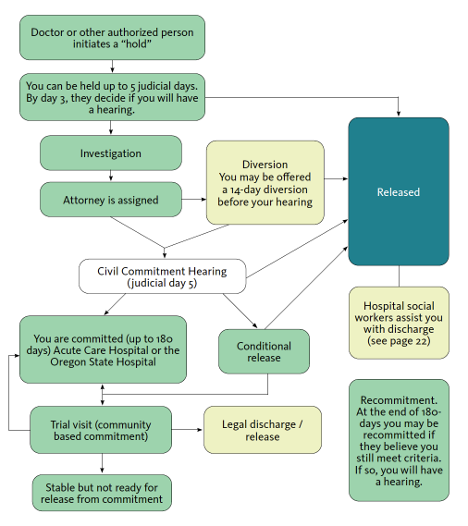
Flowchart describing the civil commitment process.
Holds and the Pre-Commitment Process
A hold — sometimes called a “pre-commitment hold” — is when a person is involuntarily held at a hospital or other mental health facility so they can receive mental health treatment.
You may only be placed on a hold if:
you are found to have a mental disorder, and
you are a danger to yourself or others.
Both conditions must be met. Not everyone who has a civil commitment hearing will be placed on a hold first. Some people remain in the community before their civil commitment hearing.
If you believe you should not be on a hold, you may request an attorney if you don’t already have one or talk to your attorney if you already have one.
Who can order a hold?
Holds are typically ordered by a doctor or a nurse practitioner at a hospital. In other cases, they may be ordered by a judge or a Community Mental Health Program (CMHP) director. Sometimes police officers will temporarily detain you and transport you to a hospital where authorized hospital staff will determine whether you should be placed on a hold.
How do I know if I am in the hospital voluntarily or have been placed on a hold?
You may ask staff at the hospital if you are there voluntarily or involuntarily. If they tell you that you are there voluntarily, you are free to leave. If they state that you are there involuntarily or on a hold, you may ask to see the “Notice of Mental Illness.” The Notice of Mental Illness should list the date that the hold started.
What type of facility can I be held at?
Generally, people on a hold are held at a hospital, such as a general hospital emergency room department, a psychiatric special emergency department, or an inpatient psychiatric hospital.
You must be held either at an approved hospital or a nonhospital that is able to provide adequate care and treatment. The facility should have trained staff and be able to meet your mental and physical health and safety needs.
If you have been charged with a crime or present a serious danger to hospital staff or property, you may be held in jail. Otherwise, you cannot be held in jail.
What if I am a voluntary patient and I want to leave?
Voluntary patients can discharge themselves from private, non-state facilities at any time. However, a doctor who believes you are dangerous to yourself or others may place a physician’s hold on you. This would require you to stay and be evaluated for civil commitment.
Generally, you would not be held voluntarily at a state facility. If you are, however, you can give them notice in writing that you want to be discharged, after which they can hold you for up to 72 hours.
How long can I be held before my civil commitment hearing?
No one can be held involuntarily for more than 5 judicial days unless a judge says so. You must be released at the end of 5 days during which the court is open and operating, unless:
you have a civil commitment hearing and a judge commits you;
you agree to voluntary treatment; or
you agree to diversion
If you are placed on a hold on Tuesday at 2:00 pm, for example, you must be released or have a hearing by the following Tuesday. This is 5 days since your hold began, not including the weekend. If 5 judicial days pass, and there is no court hearing, you are free to leave the hospital — unless you have asked to postpone the hearing or have agreed to voluntary hospitalization or diversion.
Changing facilities does not affect this timeline.
Before the end of 5 judicial days, the investigator must recommend either a hearing or your release. In some cases, you may be released without meeting an investigator. If the facility has recommended that you be committed, an investigator must meet with you and complete their investigation at least 24 hours before the hearing.
What rights do I have if I am on a pre-commitment hold?
While on a hold, you have many rights. Some of those rights are:
You have the right to an attorney, either a private attorney that you choose or an attorney appointed by the court if necessary;
You have the right to warning — both verbally and in writing — that doctor/patient confidentiality does not apply in civil commitment hearings;
You have the right to have your hearing postponed up to 5 judicial days. (Keep reading for more information on postponements.)
You have the right to accept a 14-day diversion program only if agreed to by all sides. See page 12 for more information on diversion;
You have the right to remain silent with medical staff and commitment investigators regarding criminal activity;
You have the right not to speak to the investigator for your civil commitment. This may make it difficult for the investigator to accurately assess your commitment. See Commitment Investigation for more information about the investigation.
What is a postponement?
A postponement is a delay to the civil commitment hearing for up to 5 judicial days. You have the right to request a postponement of the hearing if you or your attorney needs more time to prepare. You should talk to your attorney about whether a postponement would be appropriate in your case.
Can I be involuntarily medicated?
Yes. Under some circumstances, you can be medicated without your consent. For example, you can be medicated without consent if:
There is an emergency; or
You are unable to consent, and medication is medically necessary, appropriate, least restrictive, and in your best interest.
Before you can be involuntarily medicated, a doctor must show that a serious effort was made to obtain your consent or your guardian’s consent if you have one.
In addition, another psychiatrist must conduct an independent review. The second psychiatrist cannot provide primary or on-call care to you or to any facility employee. The facility administrator makes the final decision on whether to approve or disapprove involuntary medication.
Commitment Investigation
Who investigates civil commitment?
After a civil commitment petition is filed, an investigator from your County Mental Health Program (CMHP) investigates whether you need to be committed.
What does the investigator do?
The investigator interviews you and others who know you. The investigator also compiles information from your involuntary pre-commitment hold period. They may interview practitioners, nurses, or social workers and review records.
The investigator’s job is to:
Determine whether they think you should be committed; and
Identify if there are alternatives to commitment.
The investigator should base their decision on whether you meet the criteria for commitment. The investigator then advises a judge whether to hold a court hearing.
What are the possible outcomes of the investigation?
The investigator will make a recommendation. They may recommend one of the following:
The case should be dismissed without a hearing, and you should be released; or
You should be offered a 14-day diversion program; or
A civil commitment hearing should be held.
Alternatives to Civil Commitment
Are there alternatives to civil commitment?
Yes. You may be given the option of receiving voluntary treatment in a hospital or “outpatient” treatment in the community. You may also be given the option of a 14-day diversion program.
What is community-based / outpatient treatment?
Community-based / outpatient treatment takes place in your community or at a facility where you receive treatment but do not stay overnight or long-term. The hospital may talk to you about community-based or outpatient treatment. You have the right to participate in that treatment if it is offered to you.
What is a 14-day diversion?
A 14-day diversion program can help people avoid civil commitment. Diversion is offered to some people while they are on a pre-commitment hold, but before they have had their civil commitment hearing. The Community Mental Health Program (CMHP) Director is responsible for deciding whether to offer diversion.
If they decide you are eligible, they must offer diversion no later than 3 judicial days after you are put on the hold. When they offer diversion, it should include a statement of the treatment that you will receive. As soon as the court receives this offer, the court must notify your attorney or appoint an attorney if you do not have one.
You cannot be held for the 14-day treatment program without the agreement of both you and your attorney. If you agree to a 14-day diversion program, you can later change your mind and ask for a hearing. The hearing must be held within 5 judicial days of the request. If you refuse treatment, the CMHP Director can also request a hearing be held within 5 judicial days.
You may be discharged at any time during the 14 days, or you may agree to voluntary treatment and ask for the case to be dismissed. If you are still being held after 14 days and wish to leave, the facility cannot continue the program without a civil commitment hearing.
Civil Commitment Criteria and Hearing Process
What are the criteria for civil commitment?
You can be committed only if:
A judge finds by “clear and convincing evidence” that you have a mental disorder, and,
Because of that mental disorder, you are:
dangerous to yourself or others; or,
unable to provide for your own basic personal needs, such as health and safety.
“Clear and convincing evidence” means that the judge does not need absolute proof that the evidence presented in your case is accurate, only that it has a high chance of being accurate.
You may also be committed if you are found to meet all of the following:
You have a diagnosis of a major mental disability such as chronic schizophrenia, a chronic major affective disorder, a chronic paranoid disorder, or another chronic psychotic disorder;
You have been committed and hospitalized twice in the last 3 years;
You show symptoms or behaviors likerthose that led to your prior hospitalization; and
It is medically probable you will continue to deteriorate and become a danger to yourself or others — or be unable to provide for your own basic needs — if you are left untreated.
What is a civil commitment hearing?
At a civil commitment hearing, a judge determines whether you should be civilly committed. You, the “allegedly mentally ill person,” your attorney, the state’s attorney, and a mental health examiner are all present. Mental health examiners are doctors or other professionals certified by the state to make examinations at civil commitment proceedings.
Do I have the right to an attorney?
Yes. If you are unable to afford an attorney, the state may appoint an attorney to represent you. In some counties, public defenders’ offices have attorneys who specialize in civil commitment defense. You have the right to contact your attorney before your hearing. You can tell hospital staff, county mental health staff, or civil commitment investigators that you would like to talk to your attorney. See appendix for list for a list of offices that handle civil commitments.
Do I have a right to review records before my hearing?
Yes. The medical records put together by the court examiner’s investigation should be made available to your attorney at least 24 hours before the hearing. You can ask your attorney to let you review the records, too.
Can I call witnesses to come to my hearing?
Yes. You have a right to call witnesses to testify at your civil commitment hearing. If you want someone to testify who is not willing to do so, your attorney can help you serve a subpoena that will require the person to come to your hearing. Using a subpoena to get a witness to your hearing may delay the hearing.
Who participates in the civil commitment hearing?
A civil commitment is an open proceeding. Family, friends, and the court investigator may attend. Both you and the state may call witnesses who can also attend.
What happens in a civil commitment hearing?
During the hearing, your lawyer and the state’s representative will call witnesses to testify about your mental health and behavior. You may also testify. The state’s attorney may question your witnesses and others to testify about why you are mentally ill, dangerous, or unable to provide for your own basic needs.
Your attorney, the state’s attorney, the mental health examiner, and the judge may ask the witnesses questions. Mental health examiners usually ask you questions and give the judge written opinions of your mental condition. Mental health examiners are doctors or other professionals certified by the state to make examinations at civil commitment proceedings.
You, or your attorney, have a right to cross-examine witnesses, mental health examiners, and investigators. After all the testimony is finished, the attorneys make statements to the judge about why you should or should not be committed.
After hearing all the evidence — including reading the mental health examiner’s report — the judge will decide whether there is clear and convincing evidence that you should be committed.
What are the possible outcomes of a civil commitment hearing?
“Mentally ill” legally means someone who has a mental disorder and is dangerous to themselves or others, or someone who is unable to care for their own basic needs. Simply having a mental disorder, whether diagnosed or not, is not enough to civilly commit you on its own. If you are found by a judge not to be mentally ill, you should be released immediately, and the case is dismissed.
If the judge decides you do have a mental disorder and are dangerous to yourself or others, unable to care for your own basic needs, or meet the expanded standard regarding prior hospitalizations, the judge will order that you be civilly committed.
If a judge finds you meet the civil commitment standard, they may:
Release you, if you are willing and able to participate in treatment on a voluntary basis, and they believe you will probably do so;
Conditionally release you into the custody of a friend or relative;
Order you committed to the Oregon Health Authority for up to 180 days of treatment.
If you have been released, you are free to leave.
Can you appeal a civil commitment?
Yes. You can appeal a judge’s civil commitment decision. An appeal is a legal way to challenge the judge’s decision to commit you. A notice of appeal must be filed within 30 days of the commitment decision. If you wish to file an appeal, you should notify your attorney as soon as possible after the decision. Appeals usually take longer than 180 days to complete. This means if the commitment is reversed, you likely will not get out of the hospital any sooner, but some other rights may be preserved.
Your Rights Under Civil Commitment
How long can a civil commitment last?
A commitment can last no longer than 180 days. If the treating doctor or facility director believes you are no longer mentally ill, you must be released from the hospital or community setting, even if 180 days have not passed. The hospital cannot keep you for more than 180 days unless you agree to stay or are recommitted by court order after being offered another hearing. It is rare, but if you are committed to assisted outpatient treatment instead of a hospital, your commitment can last up to twelve months.
Where are people under civil commitment placed?
People under civil commitment can be placed in several different settings, including:
Oregon State Hospital;
Acute psychiatric care facilities;
Secure residential facilities; or
Community-based outpatient treatment.
Your placement is determined by the Community Mental Health Program Director of the county where you were committed.
What is outpatient commitment?
If you have been committed on an outpatient basis, you will be released under the supervision of the Community Mental Health Program (CMHP). The CMHP will release you if you agree to follow certain conditions. The conditions remain in effect for a period determined by the judge, up to 180 days.
What happens if I do not follow the conditions for outpatient commitment?
If you do not follow the conditions of your outpatient commitment, the CMHP Director may report you to the court. The court may require another hearing to determine whether to change your placement or the conditions on your outpatient commitment. You have the same rights to an attorney as you do during your original civil commitment hearing.
What are my rights under a hold or civil commitment?
While civilly committed, you have many rights, but they may be limited to protect you and other people in the facility from serious harm. Some of your rights are listed below.
Your communication rights:
You have the right to communicate freely in person and by reasonable access to telephones.
You have the right to send and receive sealed mail.
You have the right to a reasonable supply of writing materials and stamps.
You have the right to visit with family members, friends, advocates, and legal and medical professionals.
Your due process rights:
You have the right to file grievances with the place you have been committed if you believe your rights are being violated. These rights include the right to have your grievances considered in a fair, timely, and impartial grievance procedure.
You have the right to representation by a lawyer whenever a substantial right may be affected.
You have the right to be informed at the start of services of your rights. You have the right to be informed of the procedures for reporting the abuse of your rights.
You have the right to be notified of any limitation of your right to: send or receive mail; privacy in resting, sleeping, dressing, bathing, personal hygiene, and toileting; access to fresh air; or disposal of your personal property. You also have the right to challenge these limitations.
Your treatment rights:
You have the right to a written treatment plan, kept current with your progress.
You have the right to choose from available services those that are appropriate and consistent with your treatment plan.
You have the right to treatment in the least restrictive environment appropriate for you.
You have the right to an individualized written service plan, services based on that plan, and periodic review and reassessment of service needs.
You have the right to keep playing a role in the planning of the services that you need in a way that is appropriate to your capabilities.
You have the right not to receive services without informed, voluntary, written consent except in a medical emergency.
You have the right to be free from mechanical restraints, unless medically necessary. Any use of mechanical restraints must be documented.
You have the right to be free from potentially unusual or hazardous treatment procedures, including convulsive therapy, unless you have given express and informed consent or authorized the treatment. Under some circumstances, involuntary treatment procedures are permitted.
Your civil rights:
You have the right to wear your own clothing.
You have the right to keep personal possessions.
You have the right to religious freedom.
You have the right to a private storage area with free access.
You have the right to decline to perform routine labor tasks, except those tasks that are essential for treatment.
You have the right to reasonable compensation for all work performed other than personal housekeeping duties.
You have the right to daily access to fresh air and the outdoors.
You have the right to reasonable privacy and security in resting, sleeping, dressing, bathing, personal hygiene, and toileting.
You have the right to exercise all civil rights in the same manner and with the same effect as one not admitted to the facility, including, but not limited to, the right to dispose of property, make purchases, enter contractual relationships, and vote, unless you have been found incompetent and have not been restored to legal capacity.
Your rights to be free from abuse and neglect:
You have the right to be free from abuse or neglect and to report any incident of abuse or neglect without being subject to retaliation.
You have the right to have access to and communicate privately with any public or private rights protection program or rights advocate, including Disability Rights Oregon.
You have the right to exercise all rights described in this section without any form of retaliation or punishment.
Who do I contact if I have concerns about how I am being treated at the hospital?
If you have concerns about the way you are being treated in the hospital, you may contact:
Your civil commitment attorney.
The public defender’s office, in many counties. Your hold or civil commitment paperwork will say which county your commitment is filed in.
The hospital’s patient relations department to discuss your concerns and file an internal complaint — or to file a complaint with external oversight bodies and licensors. To do so, you may contact the hospital’s patient relations department for a full list of places to file complaints.
Office of Training, Investigation and Safety to file an abuse and neglect report at 1-855-503-SAFE (7233)
You may also consider contacting:
A private attorney, if you have concerns about medical malpractice. You can find one by calling the Oregon State Bar Referral Service at 800-452-7636.
Disability Rights Oregon: 503-243-2081 or 900 SW 5th Ave, Suite 1800, Portland, Oregon 97204.
What are my rights at the Oregon State Hospital?
As a committed person, you have many of the rights you had outside of the hospital, including the right to vote, to buy consumer items, and to marry. These rights can be limited in some cases, but never as punishment. For more information about your rights at the Oregon State Hospital, contact Disability Rights Oregon.
Who should I contact with questions about my civil commitment?
Once committed, you will have a point of contact with the county. They are usually called “post-commitment monitor” or “exceptional needs care coordinator.” They are a good person to ask questions about your care and placement. For specific questions about your legal situation, you should contact your attorney.
Release and Discharge
What is conditional release?
A conditional release means that you are released into the custody of a friend or relative, with certain conditions that you must follow. These conditions frequently include seeing a mental health worker and/or taking medication. Your friend or relative must tell the court if you do not follow the conditions for your release. The conditions stay in effect for a period decided by the judge, up to 180 days.
What is a trial visit?
After being committed, you may be released into the community on a trial basis. A trial visit comes with conditions such as taking medications or attending specific therapy sessions. You are still under commitment, but you are allowed to live in community housing, such as supportive housing or in your own home.
How can I get a trial visit or conditional release?
The decision to allow a trial visit or conditional release is up to the judge. If you have a family member or friend who would be willing to assist in your care during a conditional release, you can talk to your attorney about bringing that person to the commitment hearing as a witness.
What happens if I do not follow the conditions for release or a trial visit?
You may face another hearing before a judge if you are on conditional release or on a trial visit and you do not follow the conditions. You have the right to an attorney and all the other rights granted to you for a civil commitment hearing. You may be held in custody before the hearing. If you are being held involuntarily before your hearing, your hearing must be within 5 judicial days of when the hold began.
If the judge finds you broke a condition, the judge can continue the placement with or without additional conditions, or order you to be returned to state custody for involuntary care and treatment.
What should discharge planning look like?
Before you are discharged from mental health treatment, you should have the opportunity to plan. That planning should cover whether you want other people to support you in discharge planning, a risk assessment, figuring out your long-term care needs, coordinating with other care providers, and scheduling follow-up appointments within 7 days of discharge. While you are in civil commitment, the Oregon Health Authority may also help you apply for public benefits programs that will support your discharge.
How do I get released or discharged from civil commitment?
When you are determined to no longer be a person with mental illness, you will be given the option of leaving the facility. The Community Mental Health Program Director may also determine that voluntary treatment is in your best interest and release you from civil commitment. You then have the option of continuing your treatment voluntarily.
You will be released at the end of your commitment period (180 days) if the state does not seek recommitment. Recommitment is when the treatment staff believes you are not ready for release at the end of your commitment period. If the facility is seeking a recommitment, they would give you papers asking you to stay. You should receive any recommitment papers before your commitment is over.
Before you leave, the hospital should help you make a discharge plan and connect you with resources that you will need once you are released.
Post-Commitment
Can I protest recommitment?
Yes. If you do not want to stay in the facility where you were committed, you must protest your recommitment by signing a protest form or by telling the hospital staff. You have 14 days from the date you receive the papers to do this. You may be recommitted automatically for up to 180 days if you do not protest the recommitment.
If you protest recommitment, the hospital may not keep you in custody unless another hearing is held and the judge decides that you need to be recommitted. For the purposes of this court hearing, you have the same rights as you did in your original commitment hearing:
You have the right to be represented by an attorney, who you can either hire yourself or have appointed by the court.
You have the right to have the hearing postponed to prepare or find an attorney.
You have the right to have a doctor or other qualified person who is not on the staff of the hospital or facility where you are held examine your mental condition and report the results to the judge.
You have the right to have your own examiner appointed at no expense.
Who pays for civil commitment?
The cost of treatment during a civil commitment may be billed to you. This bill is sent to your insurer if you have insurance. Generally, the Community Mental Health Program for your county will pay any amount that remains after your insurance pays if you are committed to a private hospital. If you were treated in a nonprofit hospital, the government may pay the bill if you do not have insurance or enough money to pay. If you were treated in a state institution, you have a right to a hearing about your ability to pay.
Can I sue if I’m falsely accused of being mentally ill and am civilly committed?
Anyone can file a lawsuit. But you can only win a suit for a false accusation of mental illness if there is bad faith, malice, or no probable cause existed to believe you could need commitment.
Can I request copies of my commitment record?
Yes. You can request a transcript of what the witnesses said in court at your civil commitment hearing. There is a fee for the transcript.
Is my commitment confidential?
Somewhat. Your treatment records are confidential unless you choose to share information with specific individuals. Your hearing is confidential. The fact that you were committed is also confidential.
The fact that you are or were committed to an institution may be available in some government databases. For example, the fact that you were committed may be disclosed to determine whether you may purchase a firearm. People who were interviewed during the investigation may also know that you were in civil commitment proceedings.
Can I choose to share confidential information with other people?
While committed, you may give permission to share confidential information. If a family member or any other person you choose requests this information, the facility where you are being held must share:
your diagnosis, the condition that your care provider has identified;
your prognosis, the expected outcome of planned treatment;
your prescribed medications, as well as side effects;
your progress;
information about the civil commitment process; and
where and when you may be visited.
If you are unable to give permission to disclose confidential information, the hospital will only share your location, but it cannot provide details about your condition or care. When you are committed to a hospital or treatment center, the staff will try to inform your closest family member or a chosen friend of your admission. But that same family member or friend is not entitled to be told when you are released, moved, or seriously sick.
How are my legal rights affected by civil commitment?
Most legal rights are not affected by civil commitment. You retain most legal and civil rights — including the right to vote — unless a court has found you to be “incompetent.” However, certain rights may be limited as a result of civil commitment such as:
Firearms: A person who has been committed is forbidden from owning, buying, or possessing firearms. This restriction may be waived in some cases by following the required procedures to show that you do not pose a threat to yourself or to public safety. You may also be able to have your right to a firearm reinstated through a hearing process.
Immigration: A civil commitment may have immigration consequences. Talk to your attorney about how civil commitment could affect your immigration status.
Future Commitments: If you are committed twice within the past 3 years, it may be easier for you to be committed in the future.
Driving: A civil commitment may affect your ability to keep or get a driver’s license, specifically if you are found to be unable to exercise reasonable or ordinary control over a motor vehicle.
Chapter 7: Guilty Except for Insanity (GEI)
If you have been found Guilty Except for Insanity (GEI), you are under the jurisdiction of the Psychiatric Security Review Board (PSRB). This means the PSRB — not the court or hospital alone — decides where you are placed, what conditions you must follow, and when you may be released.
Even though you are under PSRB supervision, you retain important legal rights.
What rights do I have while under GEI?
You have the right to:
Be treated with dignity and respect
Receive mental health treatment in a safe and humane environment
Participate in your treatment planning at a level appropriate to your abilities
Be free from abuse, neglect, and unnecessary restraint
Practice your religion
Communicate with family, friends, attorneys, and advocates
File grievances and have them reviewed fairly
Access legal counsel and confidentially communicate with your attorney
Be informed about decisions affecting your placement and treatment
If you are hospitalized, you also retain many of the same basic rights as other patients, although some rights may be limited for safety, security, or treatment reasons.
What rights do I have in PSRB proceedings?
You have the right to participate in decisions about your case. This includes the right to:
Be notified of PSRB hearings
Be present at your hearings
Be represented by an attorney (appointed if you cannot afford one)
Present evidence and call witnesses
Challenge evidence presented by others
Receive a written decision from the PSRB
The PSRB must base its decisions on whether you continue to have a mental disease or defect and whether you present a substantial danger to others.
Can I request changes to my placement?
Yes. You have the right to ask the PSRB to review your status and consider:
Transfer to a less restrictive setting
Conditional release to the community
Modification of your conditions of release
Discharge from PSRB jurisdiction
Your attorney can help you request a hearing or review.
What are my rights if I am in the Oregon State Hospital?
If you are placed at the Oregon State Hospital, you have rights as a patient, including:
A written treatment plan
Participation in treatment decisions
Reasonable access to communication (mail, phone, visitors)
Access to fresh air and exercise
Protection from unnecessary seclusion or restraint
The right to file grievances
Some rights may be limited for safety or security needs, but not for punishment.
What are my rights if I am in the community?
If you are conditionally released, you have the right to:
Live in the community under conditions set by the PSRB
Receive treatment and supervision appropriate to your needs
Be informed of and understand your conditions of release
Request changes to your conditions through the PSRB
Be treated fairly by supervision providers
You must follow the conditions of your release. If you do not, the PSRB may modify your conditions or return you to a more restrictive setting.
Can I refuse treatment?
Your right to refuse treatment may be limited, especially if you are hospitalized.
In the hospital, you may be treated without your consent under certain legal procedures
In the community, treatment may be required as a condition of your release
If you disagree with required treatment, you may have the right to challenge it through a hearing or legal process.
How long does PSRB jurisdiction last?
PSRB jurisdiction can last for the maximum sentence you could have received if convicted of the offense.
During this time, the PSRB regularly reviews your case to determine whether you:
Should remain in a hospital
Can move to a less restrictive setting
Can be discharged from jurisdiction
What can I do if my rights are violated?
If you believe your rights have been violated, you can:
File a grievance with the hospital or provider
Contact your attorney
Contact Disability Rights Oregon for assistance
Raise the issue during a PSRB hearing
Chapter 8: Fitness to Proceed (Aid & Assist)
You can be involuntarily treated if you are charged with a crime and there is a question as to whether you understand the charges or are able to help with your own defense. In this situation, the court can order an evaluation, and you can be ordered to treatment for an extended period.
A person with mental illness who is accused of a crime cannot be tried for it unless he or she understands the criminal charges and consequences of the trial, can help the defense attorney, and can participate in the defense.
If you have a mental illness and you cannot understand the charges and help with your defense, you are designated as unfit to proceed or unable to aid & assist in your case.
For more detailed information, visit Know your Rights during the Aid and Assist Process.
What is the aid & assist process?
If your fitness to proceed in a criminal case is in doubt, the judge orders an evaluation. This evaluation can take place in an outpatient setting or in a hospital. Evaluations done in the hospital must be done within 30 days of the date you were sent to the hospital for evaluation.
A mental health practitioner does the evaluation to give an opinion whether you have a mental health condition that is preventing you from being able to stand trial. After the evaluation, the judge holds a hearing to decide if you are fit to proceed. If the judge finds you are fit to proceed, the criminal case continues.
Criminal charges are suspended if a judge decides you are unfit to proceed. The judge can either let you stay in the community with supervision or commit you to the hospital.
If you are in jail and found unfit to proceed, you must be transferred to the state hospital within 7 days.
Once transferred to the state hospital, you (the defendant) must be re-evaluated within 60 days. The hospital must then report back to the court on whether you are fit to proceed to trial within 90 days of the date you were transferred to the hospital.
If you still are not fit to proceed, the hospital superintendent has to tell the judge whether there is a substantial chance that you will be fit to proceed to trial in the near future.
The judge holds a hearing if the hospital tells the judge that you are unlikely to be fit to stand trial in the near future. If the judge agrees with the hospital, the judge dismisses the criminal case and discharges you from the hospital or has you civilly committed.
You stay in the hospital if the hospital says you are likely to be fit to stand trial in the near future. The hospital reports to the judge on your condition every six months. If you become able to aid & assist in a criminal trial, the criminal process resumes.
Under the aid & assist law, you can be kept in the hospital for three years or the length of the sentence that could have been imposed, whichever is shorter.
If the three years or the maximum sentence time end and you are still unfit for trial, mentally ill and dangerous to yourself or others, or unable to care for your own basic needs, the hospital can try to have you civilly committed.
Note: A recent court decision in OAC v. Mink has ordered that people charged with misdemeanors may be held at the state hospital for only 90 days, and people charged with felonies for only 6 months. There are more complicated rules for those accused of serious felonies.
Chapter 9: Hospitalization & Treatment of Criminal Defendants Found to be Sexually Dangerous
A sexually dangerous person, according to the law, means a person who, because of repeated or compulsive acts of misconduct in sexual matters, or because of a mental disease or defect, is deemed likely to continue to perform such acts and be a danger to other persons.
A criminal defendant may be hospitalized involuntarily if found by a judge to be sexually dangerous. However, the judge can make this decision only if the person has been convicted of a sexual crime and only after an evaluation and a hearing.
A person convicted of a sexual offense may be sent to the state hospital for an evaluation before sentencing. Also, if the judge has probable cause to believe the defendant is a sexually dangerous person, the judge can send the defendant to the hospital for an evaluation and report prior to sentencing. The defendant can be held in the hospital for no longer than 30 days for this evaluation.
If, after a hearing, the judge finds a convicted defendant to be sexually dangerous and treatment is available which will reduce the risk of future sexual offenses, the judge can sentence the defendant to participate in a treatment program for sexually dangerous persons.
The judge can also sentence the defendant to probation on the condition that the defendant participates in and successfully complete a treatment program for sexually dangerous persons.
Can I voluntarily request treatment as a sexually dangerous person?
Any person over age 18 may voluntarily request in writing to be admitted to the Oregon State Hospital to receive treatment as a sexually dangerous person.
If voluntarily admitted, you have the right to be released within 72 hours of submitting a written request to leave. As a voluntarily admitted person, you have the right to leave temporarily if, in the opinion of the chief medical officer, the leave will not interfere with your successful treatment or examination.
Chapter 10: Guardianship
Under Oregon law, a judge can appoint an adult to make important decisions about another person's care and well-being. This is called a protective proceeding, and the appointed adult is called a guardian. A person with a guardian, a conservator, or both is called a protected person. The relationship between a guardian and a protected person is called a guardianship.
In a protective proceeding, a judge can appoint a guardian, a conservator, or both, if you are considered incapacitated. To be considered incapacitated according to the law, you cannot make decisions well enough to get health care, food, shelter, and other care that is necessary to avoid serious physical injury or illness and, therefore, need continuing care and supervision.
A conservator is an adult appointed by a court to make important decisions for you about your finances, and you must be considered financially incapable to have a conservator appointed for you. You are considered financially incapable when a condition makes you unable to manage your financial resources effectively.
You may be legally incapacitated in some areas, but not in others. A guardianship should be limited so that your guardian is only given decision-making authority in the area that you are incapacitated. For example, a guardianship may apply only to medical treatment decisions.
The focus of all participants in a guardianship proceeding should be to benefit and assist you in a manner that maximizes your self-reliance and independence. Your guardianship should be tailored to meet your actual needs and therefore limit your guardian’s authority to make decisions for you to the specific areas in which the court determines you do not have capacity to do so yourself.
If no limitations are specified, you are under a general guardianship. Only a court can set up a guardianship. If someone states that he or she is your guardian, there must be court papers that show this is true.
If you are a protected person, you may contact the court to review the guardianship order. In an emergency, a judge can appoint a temporary guardian, a temporary conservator, or both. A judge may order that action be taken on behalf of an adult without appointment of a guardian or conservator. This is called a protective order.
Are there alternatives to guardianship?
Yes. Alternatives to guardianship should be considered in terms of whether they are in place or could be in place. Examples include other assistance from a family member or a case manager, or the Declaration for Mental Health Treatment. See Chapter 4: Making a Declaration for Mental Health Treatment.
Will I be notified that someone has petitioned the court to become my guardian?
Yes. No one can become your guardian unless you are given prior written notice and are given an opportunity to tell a judge why you do not need a guardian. A guardianship proceeding is started by filing papers with the court. Those papers are called a petition, and the person who files the petition is called the petitioner.
A petition for guardianship must state:
Who you are, and that you need a guardian
Why you need a guardian
Who should be your guardian and why he or she is qualified
Whether your guardian plans to put you in a care facility
You, the person named as needing a guardian, must be personally served with a copy of the petition.
Additionally, you must be given the opportunity to object to all or part of the petition.
How do I object to a guardianship?
You should be given a blue-colored form that explains your rights and includes three sentences that you can check to tell the court why you object to the petition. You are the respondent.
I object to the petition for the following reasons:
I do not want anyone else making any of my decisions for me.
I do not want [name of proposed guardian or conservator] making any decisions for me.
I do not want [name of proposed guardian or conservator] to make the following decisions for me:
You must sign and date your form. Also, make sure your objection form is received by the court's probate department.
You also have the right to appear in court to convince a judge that you do not need a guardian, and to have an attorney’s assistance in the process.
Once someone files a petition for guardianship, the court will send an independent investigator, called a court visitor, to meet with you to verify whether you may need a guardian.
The court visitor checks your home and talks with you. He or she will also talk with doctors, caregivers, and others who might have relevant information about whether you need a guardian. The court visitor also speaks with the proposed guardian (or conservator) and others who may have relevant information about the proposed guardian's (or conservator's) qualifications and suitability.
You should provide the court visitor with the names and contact information of people you believe have relevant information about your current decision-making ability and/or about the suitability of the proposed guardian (or conservator).
The court visitor writes a report to the court to tell the judge whether you need a guardian, and whether the person who wants to become your guardian is qualified, and the best person to do so.
A judge decides whether to appoint a guardian after reviewing all information provided, including the court visitor's report. If anyone objects to the guardianship, a hearing is held, and the judge considers all of the evidence from this hearing. Judges can appoint a guardian for you only if you meet the legal definition of incapacitated. If you do not meet the definition, the case should be dismissed.
The court may appoint counsel for the respondent or protected person in certain circumstances — for example:
if the person requests appointed counsel,
if an objection is filed,
if the court visitor recommends it, or
if the court determines the person needs legal counsel.
What are my rights if I have a guardian?
Even if you have a guardian, you keep all legal and civil rights provided by law except those that have been specifically granted to your guardian by the court. You retain the right to contact and hire an attorney and to access your own records. Also, you maintain your right to vote. At any time, you may petition the court to have the guardianship ended or to have your guardian changed.
You can be admitted to a mental health facility by your guardian if your guardian has been given the authority to make placement decisions. However, this can only happen if the doctor or another professional at the facility agrees that the admission is appropriate. You or anyone else may contact the court to object to the placement as not being in your best interest.
Disability Rights Oregon (DRO) is notified any time guardianship papers are filed for a person who lives in a mental health treatment facility, or any time a guardian proposes to put a protected person into a mental health treatment facility. DRO can provide advice to you about your rights as the (proposed) protected person in a guardianship proceeding.
A guardian can be removed or replaced by the court if the court finds that doing so is best for you. A judge may end a guardianship if he or she decides that you have regained capacity to make your own decisions.
What powers and duties does my guardian have?
Your guardian has only those powers given by the court. Generally, guardians make decisions in three primary areas:
Residential placement
Health care
General care and comfort
Your guardian should get as much input as possible from you prior to making decisions on your behalf. This includes finding out your opinions, desires, and personal values.
A guardian may not:
Authorize sterilization
Use your money to pay for room and board provided by the guardian or the guardian’s close relatives unless approved by the court
Put you in a mental health treatment facility, nursing home, or residential facility unless the guardian gives prior written notice to the court, as well as to you and other interested parties, and gives you the opportunity to object and have a hearing
Can I get a different guardian or conservator?
Yes. However, you must get court approval, which requires you to follow court procedures, including showing that the change is in your best interests. Oregon law gives preference to a family member to act as guardian.
Your choice of a replacement guardian or conservator must meet the court criteria and a new petition for the replacement guardian or conservator must be filed with the court.
Can I terminate my guardianship?
Yes, under specific circumstances. Your guardianship has been ordered by the court and lasts until your death, or until the guardianship is terminated by a court. To terminate your guardianship by court proceeding, send a letter to the probate court in the county where your guardianship proceeding took place. In the letter, state the following:
You want your guardianship terminated because you are able to make decisions for yourself and therefore are not incapacitated.
You have a medical professional who supports that you no longer need a guardian and who has written a letter to that effect. It is preferable if this letter is from a psychiatrist who can state that you have the capacity to make decisions about all matters given to your guardian by the court. (Enclose the letter.)
You would like the court visitor to investigate and make a report to the court.
You would like to have a hearing on the matter. (If your guardian agrees with you, enclose a statement of agreement from your guardian.)
You would like to request that the court appoint an attorney on the matter to represent you.
Then, the court visitor should interview you, your guardian, and any other relevant people. In the interview, present information that supports your belief that you do not need a guardian. Give the court visitor contact information for people you feel he or she should talk with regarding your capacity to make decisions. Be sure to include your doctor’s contact information. The court visitor then files a report with the judge presiding over your guardianship proceedings.
In that report, the court visitor will state either that:
the evidence supports that your guardianship should be terminated because you are no longer incapacitated; or
the evidence supports that your guardianship should continue because you remain incapacitated
The court visitor’s opinion is not definitive of whether or not the judge will find in your favor. However, the judge will consider their opinion at a hearing. If your guardian agrees that the guardianship should be terminated, then a hearing may not be necessary.
If, however, your guardian disagrees, a hearing should be held where you have the right to be present and to have an attorney. You also have the right to contact an attorney and seek legal advice.
You may contact a private attorney who practices guardianship law. The Oregon State Bar’s Lawyer Referral Service (1-800-452-7636) can provide you with the names and contact information for three attorneys who practice guardianship law and may be able to represent you.
You may also contact Disability Rights Oregon for information on guardianship termination and other guardianship issues.
Chapter 11: Patient Rights in the State Hospital System
Many patient rights in the state hospital system are guaranteed by the United States Constitution and federal laws and regulations, as well as by the Oregon Constitution, Oregon Revised Statutes (ORS), and Oregon Administrative Rules (OAR). A summary of basic patient rights must be posted in all wards of the state hospital. As a committed person, you have many of the rights you have outside of the hospital, such as the right to vote, to buy consumer items, and to marry. These rights can be limited in some cases, but never as punishment.
What are my basic rights as a patient?
As a patient in the state hospital, you have the right to:
Communicate freely
Have reasonable access to a telephone
Send and receive mail
Have a written individualized treatment plan, kept up-to-date with your progress
Participate in developing your own treatment plan at a level appropriate to your capabilities
Wear personal clothing
Practice religious freedom
Keep reasonable amounts of personal belongings on the ward in a private storage area
Be given a reasonable supply of writing materials and stamps
Not be forced to work unless necessary for treatment
Receive wages for work done in the hospital, other than personal housekeeping
Develop advance directives for care in the case of future serious medical or psychiatric illness
Daily access to fresh air and the outdoors
File grievances regarding infringement of rights
Have grievances considered in a fair, timely, and impartial grievance procedure
Petition for a writ of habeas corpus, which is a way to ask a court to decide whether detention in the hospital is legal
Representation by an attorney whenever substantial rights may be affected
Request documents in alternate formats, like Braille or sign services
Exercise these rights without any form of reprisal or punishment
A simple and clear statement of these rights must be prominently posted in each room frequented by patients in all facilities.
You must receive a copy of the statement upon admission. Upon request, copies must be sent to your attorney, guardian, relative, or friend.
What are my treatment rights?
You are also entitled to an up-to-date written treatment plan consistent with professional standards and provided in a safe and humane environment. At a minimum, you have the right to protection from psychiatric malpractice and must receive treatment that facilitates recovery or improves your mental condition.
Are AIDS/HIV tests required?
The AIDS/HIV test is an antibody test to see if you have been exposed to the AIDS virus. If the AIDS/HIV test is positive, it may mean you are infected and can infect other people. You have the right to be fully informed about the risks and benefits before deciding whether or not to take the test. Your informed consent is required before AIDS/HIV testing. If doctors in the hospital think that you do not have the capacity to decide whether to have an AIDS/HIV test, they can use the same procedure that is used for involuntary medication/treatment in order to test you.
What is seclusion and restraint?
The term restraint refers to a situation in which one person is prevented from moving by another person or by a machine or device that restricts movement.
Seclusion, or forcing a person to remain in a room by physically preventing them from leaving, is considered a type of restraint.
You have the right to be free from restraints of any form that are not medically necessary, or are used as a means of coercion, discipline, convenience, or retaliation by hospital staff.
Medication must not be used as a restraint, and must be prescribed and administered only for treatment according to acceptable medical, nursing, and pharmaceutical practices.
Restraint should only be used:
In an emergency
When other solutions are deemed ineffective to manage your behavior
What are the rules regarding the use of seclusion and/or restraint?
When seclusion and/or restraint are used, the staff must follow certain rules. You should be asked, if feasible, for your preferences or aversions to various forms of restraint. While primary consideration must be given to the need to protect you and others in the hospital, your wishes for or against particular forms of intervention should be respected by the person authorizing the use of restraint, particularly if you have post-traumatic stress disorder (PTSD). While in seclusion and/or restraint, you must be observed continually and must be checked every 15 minutes by staff. After the first hour, staff must evaluate the need for continued seclusion and/or restraint. Further evaluations must occur at least every 4 hours for adults.
If you remain calm and cooperative during two successive observations, you should either be released, or a nurse should initiate a face-to-face interaction with you at least hourly to evaluate the need for continued seclusion and/or restraint. If you are not released after the face-to-face interaction, the nurse must document the reasons for continuing seclusion and/or restraint. You should only be restrained standing, sitting, or lying on your back except in an emergency. No one should ever be restrained lying face down (otherwise known as the “prone” position) because of the risk of suffocation.
You must be offered food according to regular meal and snack schedules, as well as the opportunity to use the toilet at regular intervals. While in physical restraints, you must be allowed to exercise a minimum of 10 minutes for every two hours in physical restraints, except while asleep.
Your environment while in seclusion and/or restraint must be made as comfortable as reasonably possible.
All restraint orders expire within 12 hours. After 12 hours, you must be re-evaluated and a new restraint order made. After 24 hours of continuous restraint, the hospital staff must obtain a second opinion before continuing the restraint.
Can seclusion and/or restraint be part of a treatment plan?
Seclusion and/or restraint may be used as part of a treatment plan if you give your consent. If you do not agree, seclusion and/or restraint may be used only if you are found incapable of making decisions, and the involuntary treatment procedure is used. Seclusion and/or restraint must be specifically for treatment purposes, not for punishment or the convenience of staff.
What is the level system at the state hospital?
Most wards have a level system. This system lays out the freedoms and responsibilities you can earn by following your treatment program. Levels are described by letters or numbers. Your treatment team decides your level. Your legal rights are not affected by level decisions. The level system must be used for treatment purposes only, never for discipline or punishment. If you are unable to change levels, use grievance procedures to question why you are not advancing.
Is going outside a right?
Yes. You have the right to go outside and get fresh air at least once every day and get regular outdoor exercise unless weather or treatment needs make it impossible.
What is a Social Security payee?
If a doctor tells the Social Security Administration that you cannot handle your own money, Social Security appoints an individual or agency to keep your Social Security Disability Insurance (SSDI) money and spend it on your behalf. This individual or agency is called a payee.
You have the right to protest the appointment of a payee, to request a different payee, or to ask permission to manage your own money. Contact Social Security at 1-800-772-1213 with any complaints about a payee.
If the state hospital is appointed as your payee, it usually gives some or all of the money to the state to pay for the cost of your care. If you have special financial needs, such as money for discharge, some of the money paid for cost of care can be returned to you. A friend or relative may also be appointed as payee and cannot be required to give any of your Social Security money to the state to pay for the cost of care. The payee may save this money to purchase items that will improve conditions for you while in the hospital or to help you in the community upon release from the hospital.
Are my Social Security benefits suspended while I’m at the state hospital?
Your Supplemental Security Income (SSI) benefits are totally suspended while you are at the state hospital. Suspension of your Social Security Disability Insurance (SSDI) benefits while you are at the state hospital depends upon the reason you are at the hospital. If you are a patient under PSRB jurisdiction, you will not receive any kind of Social Security benefits while you are at the hospital. If you have been civilly committed, you will continue to receive SSDI and Social Security retirement benefits. If you are an aid & assist patient, you will continue to receive SSDI benefits.
What is hospital cost of care?
Hospital cost of care is the cost of your hospitalization. As a current or former patient at the state hospital, you can be billed for the cost of your hospital care — even if the hospitalization was involuntary.
The state looks at your income, property, and resources and determines whether you are able to pay for your own hospital care, and if so, how much. The state is only supposed to charge you what you can afford to pay. If the state decides you should be able to pay for some or all of your hospital care, the state sends out an ability to pay order. You can request a hearing to challenge the order once you receive it. This hearing is a chance for you to explain why you do not have the money or other resources to pay for the cost of your hospitalization.
If the hearing officer decides you have to pay hospitalization costs, that decision can be appealed to court. Patients charged for the cost of care should explain any extraordinary circumstances they may be facing and ask that the state waive some or all of those costs.
You cannot be forced to sign over money to pay for your care, and the hospital cannot punish or treat you differently because you do not or cannot pay your hospital bill.
Are searches allowed?
Yes. You may be searched when staff have reasonable cause to believe you have a prohibited item. Only a nurse or doctor can examine your body cavities, and then only if the superintendent gives permission. Each hospital or facility has policies or rules about how and when searches can be conducted.
Who can be transferred to another hospital?
If you have been civilly committed, you can be transferred to another hospital or facility under certain conditions. The Addictions & Mental Health (AMH) Division can transfer you if the transfer is for good cause and is in your best interest. If you object to the transfer, it must be suspended until the grievance procedure is completed, unless an immediate transfer is necessary for your health or safety. The superintendent must have written procedures for resolving grievances about transfers.
No one should ever be transferred to another facility as punishment.
What are the rules regarding ward transfers in the same facility?
Transfer to another ward in the same facility is very different. You can be transferred to different wards for treatment-related reasons or for security reasons without the right to a hearing. Staff must inform you of the transfer before the transfer takes place unless it is an emergency.
If you are transferred to a maximum-security ward, you must be told by staff what behavior will make it possible for you to return to a less restrictive ward. If you do not want to be transferred to another ward you should file a grievance. However, filing a grievance will not necessarily stop your transfer to a different ward.
What can I do if I believe my rights are being violated at the state hospital?
First, try to resolve the problem informally. Start by talking to your case monitor. Try talking with the staff person involved, or with another staff person. Talk to your treatment team to try to resolve the situation. If that does not help, file a grievance.
What is a grievance, and how do I file one?
A grievance is a written statement explaining a complaint. The state hospital has a four-level grievance procedure:
Level One: Treatment Team
Level Two: Grievance Committee
Level Three: Oregon State Hospital superintendent
Level Four: Addictions & Mental Health (AMH) Division administrator
First, file a written grievance with your treatment team. The grievance must be in writing and may be written on a form provided by staff or on any piece of paper and given to staff as a grievance.
Hospital staff is required to help you if you want to file a grievance or appeal a decision but are unable to write. Staff must give your grievance to the grievance coordinator. Then, your treatment team meets with you about your grievance and considers your complaint. The treatment team then gives you a written response to your grievance within 20 days of the date you originally made the written complaint.
If you are not satisfied with your treatment team’s response to your complaint or with the solution proposed by your treatment team, you may take your grievance to the next level — Level Two — by appealing your treatment team’s decision to the hospital Grievance Committee.
Your appeal has to be in writing, state your disagreement with your treatment team’s decision, and include a hearing request to the Grievance Committee. The appeal should be filed within 14 days of the treatment team’s decision.
The Grievance Committee sets a date for a hearing on your grievance within 21 days of when your Level Two grievance was sent in and informs you in writing what date and what time the hearing will be held — at least three days before the hearing.
At that hearing, you may be represented by an advocate, an attorney, or anyone else. You have to get your own advocate or attorney — neither is automatically provided. You can ask witnesses to testify or answer questions, and are allowed to question witnesses called by the Grievance Committee. After the hearing, the Grievance Committee makes its decision, puts it in writing, and gives it to you within 21 days.
If you disagree with the Grievance Committee’s decision in the Level Two grievance, you may appeal to the hospital superintendent — Level Three. Your appeal request must be in writing and state the reasons for requesting the review. The superintendent responds to your grievance in writing within 30 days.
If you are not satisfied with the superintendent’s decision, you can appeal to the Addictions & Mental Health (AMH) Division administrator — Level Four. Your request for appeal must be in writing. The AMH administrator makes a decision on the complaint, puts it in writing, and provides it to you within 30 days of your appeal request.
The AMH administrator’s decision is final, but you may have the right to ask a court to hear your complaint. Talk to an attorney to determine if your complaint is one that could be filed in court.
What is an emergency grievance?
If you have a grievance that needs to be resolved quickly because you will suffer irreparable harm to a substantial right if it is not resolved promptly, you can file an emergency grievance. An emergency grievance is filed like any other grievance — with a complaint in writing either on a grievance form or any piece of paper — but you should clearly ask for it to be treated as an emergency.
Your emergency grievance will be reviewed right away by the grievance coordinator, and then directly with the Grievance Committee.
What are the protections from abuse and neglect?
You have the right to be protected from physical and mental abuse and neglect. This includes:
Hitting
Kicking
Scratching
Pinching
Choking
Pushing
Ridicule
Harassment
Coercion
Threats
Cursing
Sexual assault or exploitation
Neglect in care
Lack of food
If you believe you have been abused or neglected, you can report the abuse to any state hospital staff member in writing. Staff is required to help you write the abuse report if you are unable to do so. It can be written on any piece of paper — no form is required. The abuse report goes to the Office of Training, Investigations and Safety (OTIS). OTIS begins an investigation and determines whether you have been subjected to abuse or neglect.
Requesting an investigation of abuse and neglect does not stop you from bringing other claims against the hospital for personal injury or reporting the incident to the state police as a crime.
How is an abuse report different from a grievance?
An abuse report is a written complaint of physical or mental abuse or neglect reviewed by the Office of Training, Investigations and Safety (OTIS).
Complaints about care, rules or policies, the lack of rules or policies, or any action taken by staff towards you or other patients at the hospital should be addressed by filing a grievance. Grievances are written complaints reviewed first by hospital staff, then by upper-level hospital administrators, and, if unresolved, by the Grievance Committee.
If you file a grievance, but the Grievance Committee decides it is actually an allegation of abuse/neglect, the grievance will be treated as an abuse report and sent directly to OTIS for review.
If you feel you are being abused or neglected at the state hospital, you should file an abuse report. If your rights have been violated, you should file either a grievance or an abuse report, or both.
You do not have to be a patient at a state hospital to make a report of abuse or neglect. Anyone who believes a patient is being abused or neglected at a state hospital should make a report to OTIS in writing or by phone.
Who can sue the state hospital?
Only people with a legal claim can sue the hospital. You might be able to sue the hospital for violations of your civil rights if you were injured while in the state hospital, or for various other reasons. You cannot be punished or retaliated against for suing the hospital. Because the hospital is part of the state government, you generally must notify the state of a loss or injury with a tort claim notice within 180 days of the loss or injury in order to keep the right to file a lawsuit. Anyone who might have a claim against the hospital or any public agency should speak to an attorney as soon as possible. An attorney can tell whether the claim is valid and what time deadlines apply.
Are there other legal tools available?
Other ways to voice your concern about the state hospital include filing complaints with agencies that fund or certify the hospital, such as the Centers for Medicaid & Medicare Services or Joint Commission.
How can I get out of the state hospital?
As soon as you have been civilly committed to the hospital, state workers should start planning for your release. When the hospital determines you are no longer mentally ill or are no longer a danger (or that the danger can be managed in a less restrictive setting), the hospital is responsible for finding an appropriate place in the community for you to live. You may be allowed to go home to your family, or may be required to go to a group home or other community facility until your treatment needs change.
Discharge becomes complicated for individuals at the hospital under an Aid and Assist or GEI order. Individuals under Aid and Assist orders should be discharged whenever they are found not able to be restored in a timely manner or fully restored. There are statutory guidelines in the Aid and Assist section (above) that limit the time a person may be held in the hospital. Individuals subject to GEI orders are under the jurisdiction of the PSRB, which complicates discharge.
Chapter 12: Involuntary Treatment in the State Hospital System
(For more detailed information on involuntary treatment, contact Disability Rights Oregon or read our Involuntary Medication Hearing Handbook.)
Can I be involved in my own treatment decisions?
You have the right to make informed decisions about your own mental health treatment. All patients must receive information about treatment and medications suggested by doctors before agreeing to treatment.
You should always be informed, but hospitals can treat without consent for many routine things. If hospital staff want to treat you with a significant procedure, they must either get your consent or prove they have the right to treat you without your consent. A significant procedure is a treatment that involves a substantial risk or requires informed consent under state rules, such as psychotropic medication or electroconvulsive therapy (ECT).
The hospital can also treat you without your consent in an emergency.
What if my doctor believes I need psychotropic medication?
Your doctor must talk with you about the proposed treatment, including:
Your mental health diagnosis
The possible benefits of taking the medication
The possible risks and side effects of taking the medication
What your doctor believes will happen if you don’t take the medication
Other available treatment options
What happens if I agree to take the medication?
If you agree to treatment, the hospital may provide the medication. If you later change your mind, you may request that the medication be safely reduced or discontinued.
What if I don’t agree to take the medication?
The hospital may require you to undergo a significant procedure without your consent if it believes there is good cause. Good cause means that:
You can’t make your own decision about whether to take the medication because you can’t understand and weigh the risks and benefits of the treatment options
The medication is likely to help you
It’s the most appropriate treatment for your condition
All other treatments (other than medication) aren’t right for you
What happens if my doctor believes there is good cause to require me to take the medication?
If your doctor thinks there is good cause to require you to accept treatment, the following must happen:
Your doctor must meet with you to talk about your treatment options.
A second doctor who does not work for the state hospital must also meet with you. This doctor gives a second opinion about whether there is good cause to require you to take medication.
A medication educator — a person who knows all about the specific medication — must meet with you to give you information about the medication and answer your questions.
The Chief Medical Officer or Superintendent of the hospital must consider both doctors’ opinions and make a final decision about whether there is good cause to require you to take medication.
If the Chief Medical Officer or Superintendent decides that there is good cause to require you to take medication, you will be given written notice of the hospital’s plan to give you medication without your consent. This written notice will also tell you about your right to request a hearing, if you disagree with the hospital’s decision.
How can I show the doctors that I can make my own decisions about medication?
Tell the doctors what you think the possible risks and benefits from taking the medication might be, what might happen if you take no medication, and which other treatments you think would work better for you, and why.
The doctors will consider what you say when they decide whether, in their opinion, you can reasonably weigh the risks and benefits of the medication — and the risks and benefits of not taking any medication.
What happens in an emergency?
In the case of an emergency, the hospital can also treat you without your consent in order to:
Preserve your life or physical health if there is not time to obtain informed consent according to law
Avoid immediate physical harm to others
I got a written notice that the hospital plans to require me to take medication. What are my options?
You have three options:
Agree to take the medication.
Talk to your doctor about alternatives that may work better for you.
Refuse to take the medication and request a hearing.
If you agree to take the medication, remember that you can change your mind at any time, refuse to take the medication, and ask for a hearing.
How do I ask for a hearing?
The written notice from the hospital will include a Request for Hearing Form. Fill out this form, and give it to hospital staff.
If you need help filling out the form, ask a staff member for assistance. Or, tell your doctor that you want a hearing. You can request another form at any time. Also see Model Form: Request for Hearing Form.
Can I ask for an attorney to represent me at the hearing?
Yes. You have the right to be represented by an attorney at your hearing.
If you request an attorney on the form, one will be appointed for you.
You may also hire a private attorney at your own expense.
What happens after I request a hearing?
After you ask for a hearing, you will get a written notice telling you the date for your hearing. Your hearing will usually be held within 14 days of your request.
Your attorney will help you decide if there are any witnesses who have information that can help. You also have the right to represent yourself at your hearing.
What will happen at my medication hearing?
The hearing is held in a room in the hospital. The administrative law judge is in charge of the hearing. The judge listens to testimony from you, your doctor, and other witnesses. The hearing is your chance to prove to the judge that you should be allowed to refuse medication.
You will have the chance to show the judge:
That you understand the possible risks and benefits if you take the medication;
Why you’ve decided that the risks outweigh the benefits of taking the medication;
That you understand the possible risks and benefits of not taking medication;
Why the medication is not the best treatment for you; and
That there are other less risky treatments that could help you.
The hospital must prove there is no good cause to require medication against your wishes.
When will the judge decide?
After the hearing, the judge usually sends send you and the hospital a written decision within one to two business days. Hospital staff must give you the judge’s decision and explain it to you.
What happens after the judge makes a decision?
If the judge agrees with you, the hospital cannot require you to take medication against your wishes.
If the judge agrees with the hospital, the hospital can start giving you the medication right away.
Can I appeal or change the judge’s decision?
Yes. If you disagree with the judge’s decision, you have three options:
Decide to take the medication even though you disagree.
Ask the judge to reconsider or request another hearing.
Ask the Oregon Court of Appeals to review the judge’s decision.
There are strict deadlines for asking for any type of appeal, rehearing, or reconsideration. Be sure to read the information in the judge’s written decision carefully.
Can the hospital require me to take medication if I appeal or challenge the judge’s decision?
Yes. The hospital may continue treatment during an appeal. You may request a stay, but it is not automatically granted.
A stay is an order that tells the hospital to stop giving you the medication until the appeal or reconsideration/rehearing is over.
How long can medication be required?
If the judge decides that the hospital can require you to take medication, it can do so only for 180 days (six months). After 180 days, the hospital must repeat the process if it seeks to continue giving you medication against your wishes. You will have an opportunity for another hearing.
If you regain capacity at any time, the hospital should stop requiring you to take medication. If you believe that your mental health has significantly improved since your last hearing and that you now have the capacity to make your own treatment decisions, you can ask for another hearing before 180 days are over.
Chapter 13: Access to Medical Records & Legal Assistance
Medical records are confidential. Usually, medical records cannot be given to anyone outside the hospital without your written consent or that of your guardian. The law only allows the release of medical records without consent in limited circumstances.
For example, in a medical emergency, records may be released to other service providers for treatment purposes or to governmental agencies for financial reimbursement. You may withdraw permission to share your records by telling medical staff, typically in writing.
Can I access my own medical records?
You have the right to see all your own medical records, except for parts a doctor believes might cause harm to you if you were to see them. If the doctor refuses to release your medical records, you can file a grievance and request that another qualified provider review the records. You may be responsible for the cost of this review.
If the private doctor believes the records will not cause harm, that doctor may release the records to you.
What is a release of information?
If you have signed a release of information, a family member, friend, or advocate may access your medical records. There may be restrictions on sharing this information, if a doctor states it may be harmful to your health.
Can others access my confidential information?
When you are admitted to a hospital or facility, staff may attempt to notify your next of kin or another person you choose. You may also request that this information not be shared.
Facilities respond to direct questions about where you are being held if you are unable to say whether or not you would like your information released, unless the doctor determines it is not in your best interest.
If you give your consent, the hospital may tell a family member or a designated person:
Where you are being held
Your diagnosis and prognosis
Prescribed medications and any side effects
Your progress
Where and when visits can take place
Information about any upcoming civil commitment process
By signing a release, you can request that an outside observer or family member be present at your treatment team meetings.
Do I have access to courts and attorneys while I’m hospitalized?
While hospitalized, you have the right to communicate confidentially with an attorney and may hire an attorney for any purpose.
In some cases, an attorney is appointed if you cannot afford one. For example, attorneys are appointed in:
civil commitment proceedings
Psychiatric Security Review Board (PSRB) matters, if you are under PSRB jurisdiction and cannot afford to hire an attorney
For more information about appointed counsel in criminal cases, contact Oregon’s Office of Public Defense Services.
Everyone has the right to use a law library or other legal research resources. Access can be withheld only for security or staffing reasons. Staff must assist with local and long-distance calls to an attorney. A private telephone must be provided for all calls to an attorney.
Additionally, while hospitalized, you must be allowed to contact Disability Rights Oregon at any time for assistance.
Copyright © 2026 Disability Rights Oregon
900 SW 5th Ave, Suite 1800, Portland OR 97204
E-mail: welcome@droregon.org
Website: droregon.org
Disability Rights Oregon is tax-exempt under Section 501(c)(3) of the Internal Revenue Code. Contributions are tax-deductible and will be used to promote the rights of Oregonians with disabilities.
Portions of this document may be reproduced without permission, provided that Disability Rights Oregon is appropriately credited.
NOTICE: This document is not intended as a substitute for legal advice. Federal and state law can change at any time. You may wish to contact Disability Rights Oregon or consult with an attorney in your community if you require further information.