
When the Oregon Needs Assessment slashed home care hours by nearly 40 percent, one family faced an impossible choice. Here's how advocacy made all the difference.
You do not have to navigate the Oregon Needs Assessment alone. Our advocates are here to help you understand your options, document your needs, and fight for the care your loved ones need to thrive.
For years, Pat—a single mother and widow—has managed the round-the-clock care that her adult daughter, Erin, needs to thrive in their Cannon Beach community. Over 600 hours of in-home care each month makes it possible for Erin to feed the birds she loves, communicate with family members who understand her, and live in the comfort of familiar surroundings.
Then came the letter that changed everything.
The Oregon Needs Assessment (ONA)—a new process the state uses to determine how many in-home care hours a person with disabilities needs—cut Erin’s essential in-home care hours by nearly 40 percent. This massive reduction, the largest our organization has seen to date, wasn't just a number on paper. It was an existential threat to Erin and to the life she and her family had built together.
“Without these hours and support from family, Erin would need to be in foster care home or other institution. She wouldn’t survive that.”
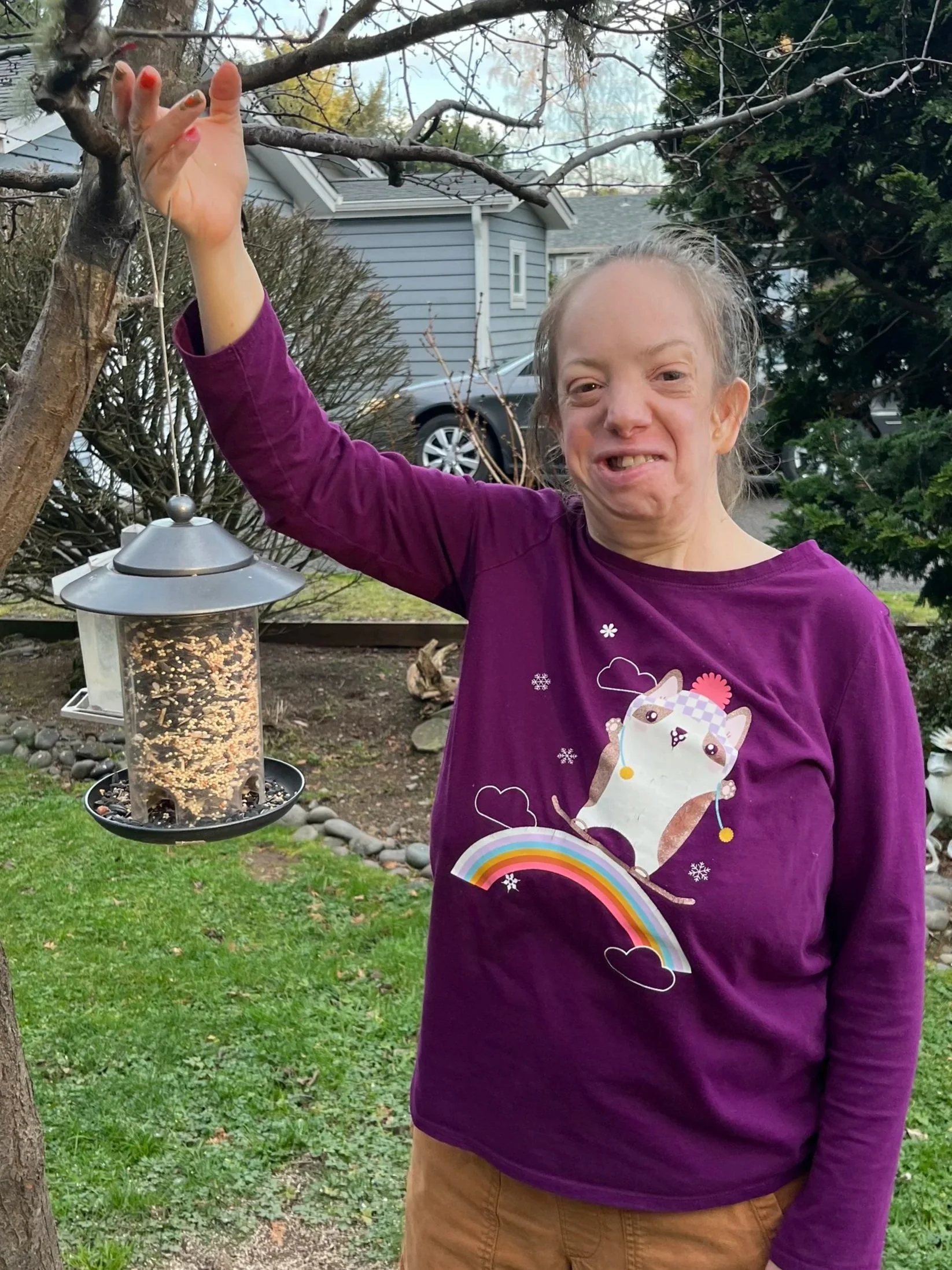
Feeding the birds in her Cannon Beach neighborhood is a daily highlight for Erin (above). Disability Rights Oregon helped Erin and her mother, Pat, regain crucial in-home care after the Oregon Needs Assessment made significant cuts to hours.
Erin is a 45-year-old woman with CHARGE Syndrome, a rare, complex genetic disorder that affects multiple body systems and impacts every aspect of daily living. One of the disorder’s impacts to Erin is debilitating layered seizures that can require repeat emergency room visits. While the seizures have become less frequent—thanks to lifestyle changes and wholistic healthcare that Pat investigated—Erin still needs 24-7 care, including throughout the night for restroom assistance, changing sleeping positions, and more.
Taking a Different Approach
When Pat reached out to Disability Rights Oregon on Erin’s behalf, they had already submitted an ONA exceptions request for increased hours, but the state said No. As a result, we immediately began working to appeal the state’s decision while also looking for solutions that didn't require waiting for a hearing.
That's when Camille Iacangelo, an advocate on our Developmental Disability Rights Project, helped the family do something many don't know is an option: asking the state to redo the needs assessment entirely.
3 Reasons to Ask for Another ONA
You can request another ONA when a prior assessment reduced in-home care hours, leaving a person with disabilities in danger including:
Safety risk: Not enough in-home care hours to prevent harm to self or others
Missed needs: More care needed than the initial assessment captured
Social isolation: Not enough hours to participate in community life
A Hidden Gap in Advocacy
As we've reviewed ONA decisions and exceptions requests denied by the state, our advocates have noticed a troubling pattern: families aren't fully describing what they actually do to take care of their loved ones. “The information they are submitting doesn't match what we hear when talking with them,” Camille explained.
To help, Disability Rights Oregon developed simple but powerful questions to help families describe their realities at home:
"If you were to hire a direct support professional, and you were going to take a trip that same day, what would be in that binder you leave behind regarding taking care of your family member? How many hours would they need to work?"
These questions helped Pat fully capture the complexity of her daughter’s needs—not just the obvious physical care, but the nuanced communication support, the overnight assistance, and the daily routines that give Erin's life structure and meaning.
A Hard-Won Victory
Thanks to Pat actively asking for another ONA and working with us to submit more details about needed care, Erin’s hours were fully restored in December 2025—before the appeal hearing even took place.
“Having hours reinstated was a huge relief. It’s the first good night’s sleep I’ve had in six months.”
But the victory was about more than hours. Erin, who has hearing loss and finds speech extremely challenging, has blossomed at home with people who understand her.
"With closer natural supports, she gets more and more comfortable," Pat shared. "Ever since Erin started talking, she hasn’t quit. She’s making up for all the years!
A Message for Other Families
When we asked Pat what she would say to other families facing similar battles, her answer was immediate and passionate:
“Contact Disability Rights Oregon! Just having someone to talk to about it was great. Find yourself some good, strong advocates. You need people you can trust that will support you through this process.”
What We've Learned
This case taught us important lessons about the Oregon Needs Assessment process. Families need to know about the exceptions request process and that they can ask for a repeat assessment. Families need guidance on how to fully document their caregiving reality. And perhaps most importantly, families need advocates who will stand with them through the exhausting, often absurd red tape.
“Helping Erin regain her in-home care hours was incredibly gratifying,” said Camille. “I could feel the weight on Pat’s shoulders go away for just a moment because she no longer had to worry.”
Are You Facing a Similar Challenge?
You don't have to navigate the Oregon Needs Assessment alone. Our advocates are here to help you understand your options, document your needs, and fight for the care your loved ones need to thrive.